Albert Einstein had wild hair, a playful smile, and the most famous brain in history. He changed the way we understand light, time, space, and gravity — just by asking simple "what if?" questions and thinking very, very hard.
Quick facts
- Born
- 14 March 1879, Ulm, Germany
- Died
- 18 April 1955, Princeton, USA
- Famous for
- The theory of relativity and E = mc²
- Big prize
- Nobel Prize in Physics, 1921
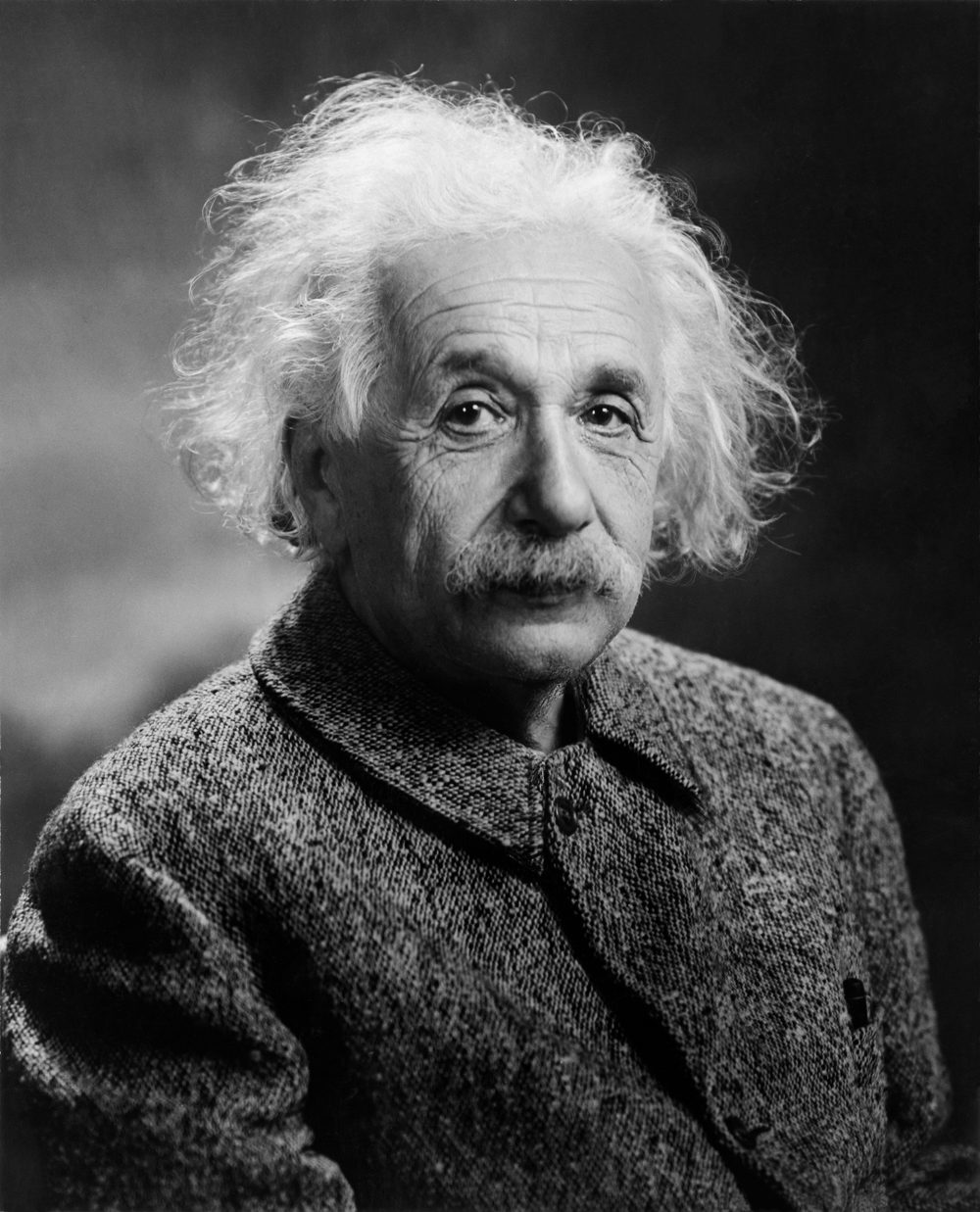 🖼️ Photo coming soon
A curious boy
When Albert was about five and sick in bed, his father gave him a compass. He was amazed that the needle always pointed the same way, pulled by an invisible force. That feeling of wonder never left him. He loved the violin, daydreaming, and puzzles — and he wondered about things most people never stop to ask.
The year everything changed (1905)
While working a quiet job in a patent office in Switzerland, Einstein had a burst of genius. In just one year — 1905 — he published ideas that shook science:
- Special relativity: time and space aren't fixed — they can stretch depending on how fast you move!
- E = mc²: the idea that tiny bits of matter hold enormous amounts of energy.
- The photoelectric effect: showing light comes in little packets (this one later won him the Nobel Prize).
Bending space and time
In 1915 Einstein went even further with general relativity, which says that heavy things like the Sun actually bend space around them — and that's what we feel as gravity. In 1919, scientists watching an eclipse proved he was right. Overnight, Einstein became world-famous.
"Imagination is more important than knowledge." — Albert Einstein
A kind and brave person
Einstein left Germany in 1933 when dangerous leaders came to power, and made a new home in America at Princeton. He cared about peace and fairness, spoke up against unfairness, and even had a famous chat about life and beauty with the poet Rabindranath Tagore in 1930.
Why we remember him
Einstein showed that curiosity and imagination can be just as powerful as any machine. His ideas help run GPS in phones, explain black holes and stars, and remind us that asking "why?" is how the biggest discoveries begin.